

By: Scott Findlay, Principal Scientist at Deep Genomics
This is the story of how we built a frontier model for predicting siRNA off-target effects in less than a year, with fit-for-purpose data and seven lab-in-the-AI-loop iterations.
Only three years ago, as I transitioned from MIT’s Biology department to a role at Deep Genomics, I started my plunge into the rapidly accelerating field of ML/AI models for genomics and genetic medicine. AI is a perfect fit for genetic medicine, as Deep Genomics founder Brendan Frey explains in this post. Immediately, it was obvious to me that there was an alignment problem of sorts–not quite the high-stakes “agentic AI apocalypse" problem we’ve become uncomfortably familiar with in recent months, rather something more concrete–more often than not, the data we had didn’t align with what we needed to train the models we wanted to build.
At the time, a lot of efforts seemed limited by which datasets were already publicly available. At Deep Genomics, we were already at the frontier of developing such models, for example training on data from GTEx and fine-tuning on disease-specific data to build a biological foundation model (BioFM) called BigRNA, which can accurately predict high resolution transcript expression from arbitrary genetic sequences and therapeutic interventions.
In Fall of 2025, we took on the challenge of predicting off-target effects of siRNAs in vitro and in vivo. We found publicly available data sources for transcriptome-wide siRNA screens were all over the place: very few siRNAs per study, pools of siRNAs designed against the same target but with distinct guide sequences, shRNAs (would these behave the same as siRNAs?), unclear chemistry, and vague controls. This was a clear opportunity to generate our own fit-for-purpose siRNA dataset that could sit atop the trillions of datapoints used to train our foundation models. This is the story of the data behind DeepRNAi, our predictive model for siRNA efficacy and specificity introduced last week by the Director of our AI Lab, Albi Celaj.
Having previously heard “If only we had that data” deep into a project one too many times, we immediately met as experimental, computational, and machine learning scientists to ask a simple question–what kind of siRNAs do we want to screen to train DeepRNAi? We’d seen others attempt to repurpose data from therapeutic program screens, but these tended to rigorously filter siRNAs with many high complementarity off-targets–great for programs, and for model evaluation, but not for building models. If we wanted to build a model to predict off-target liabilities, we needed to be able to train on many examples of off-target transcripts knocked down by siRNAs; we needed to screen lots of “dirty” siRNAs! Since we didn’t (yet) have a model to identify such siRNAs, we relied on standard methodology in the field, “string matching,” to tally all Near-Perfect Matches (NPMs) between an siRNA guide strand and putative off-target transcripts.
Armed with a road map to finding dirty siRNAs, some were eager to start screening right away. “Can we order some siRNAs this week?” It was a reasonable question, but our experience as an integrated organization told us we had to go slow to go fast. So we paused, and got some rigorous computational tooling in place before a single siRNA oligo was synthesized, let alone screened in the lab. Very quickly, we had siFORGE (built on top of GenomeKit) which allowed us to computationally tile any human target gene to enumerate all possible siRNA sequences, apply standard on-target efficacy scoring algorithms, and systematically count, for each possible siRNA guide strand, NPMs across the transcriptome at desired edit distances. This meant we weren’t simply guessing at how many NPMs a typical siRNA had, we were comprehensively assessing an entire landscape of possible siRNAs and then selecting the ideal training set. In the end, our siRNA design and selection strategy was straightforward, but impactful: screen siRNAs with a wide range of putative NPM off-target counts, enriching for those with high counts to achieve an overall average of ~100 NPMs per siRNA. We estimated that this translated to a rate of useful training signals ~16-fold higher than what repurposing lead therapeutic screening data would offer. Our fit-for-purpose dataset was born. Now it was time to hit “order” and get to screening.
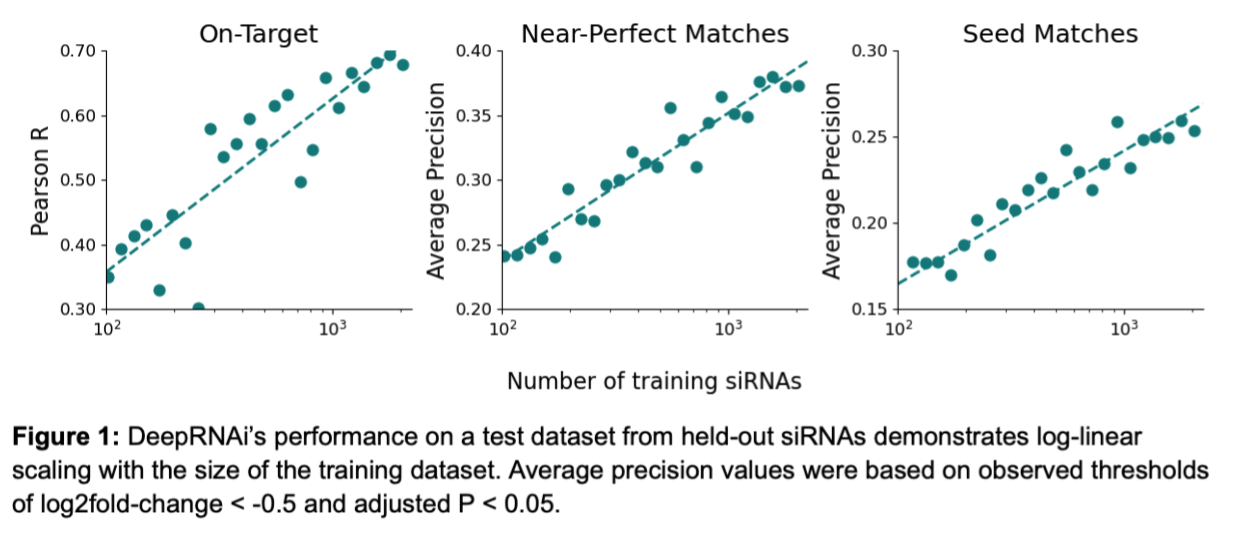
We started small in our screening efforts, proceeding target gene by target gene, and rapidly set up train/test splits to gather feedback from our evaluations to guide the next batch of oligo designs and cell line screens. With our lab firmly in the loop, we could ingest new data into the model, decide if we needed (for example) screening data for more targets, in more cell lines, or repeated screens of the same siRNAs, and then point the next round of design and screening in the desired direction. Within months we had our foot fully on the gas, culminating in turning around a single transcriptome-wide screen of 1,000 siRNAs in a matter of weeks. Now, at over 2,000 siRNAs screened, DeepRNAi is trained on screening data from over 15 million siRNA-transcript pairs. Performance continues to scale well (Figure 1), and we are fast approaching the limits of experimental reproducibility in our cell line models, as Albi’s recent post illustrated.
I’d like to emphasize that rapidly generating this screening data was not a trivial effort, but one that we executed smoothly owing to years of investment and expertise in molecular biological screening assay development, automation workflows, and data handling.
Lastly, I’d like to leave us with an important perspective: There’s no substitute for fit-for-purpose, domain specific data; Not general purpose LLMs (they aren’t trained on any siRNA screening data, and they don’t understand the language of molecular biology), and not even Deep Genomics’ BioFMs, at least in isolation. Sure, the latter have a rich understanding of endogenous biological processes that can help inform this problem space, but siRNAs themselves aren’t even endogenous molecules. At the end of the day, there is no short cut to building models performative enough to impact drug discovery. You simply need domain specific data.
Armed with 15 million siRNA-transcript data points, we were off to the races–or so we thought. The data held a puzzle: the vast majority of the signal could not be attributed to direct, hybridization-dependent off-target interactions, the very interactions we needed the model to learn. We had the scale, now we had to find the signal.
In our next post, Albi Celaj will explain how we did this!
To read the previous pieces in this series, visit the Deep Genomics blog here.