
By Brendan Frey, CIO and Co-founder of Deep Genomics
Summary: Genetic medicine–biology and molecules derived from DNA and RNA sequences–are positioned to play an increasing role in the future of drug discovery. They act at the root level of disease and can be more specific, less toxic and longer-lasting than small molecules, antibodies or peptides. However, they have been stuck in their own kind of ‘AI winter’, only accounting for 2% of revenues. I believe that the potential of genetic medicine can only be realized with a full-stack AI solution. Genetic medicine is programmable at the sequence level, so it is amenable to discovery and optimization with an integrated AI technology stack that includes well-aligned computational models, agentic workflows and lab-in-the-loop testing. By matching the scientific stack of genetic medicine with an AI technology stack, we can unlock this area, move 2% to 20%, and usher in a new era of safe and effective therapies.
I’ve spent much of my career thinking about AI, biology and drug discovery, and I’d like to start sharing more of what I’ve learned—and what I think the field is getting right and wrong. This is the first of a series of posts in which my colleagues and I will share new results, perspectives, and occasionally contrarian views. There’s a lot to talk about!
One thing I need to clear up first: When I say ‘AI’ here, I am not talking about current agentic AI systems and large language models whose intelligence is highly constrained by human language patterns. I’m talking about AI more broadly–see my post here.
Medicine offers perhaps the greatest opportunity for AI to solve problems that truly matter to humanity. As Dario Amodei, CEO of Anthropic, recently said, “I think by far the most accurate criticism of AI companies including Anthropic is that we haven’t yet delivered on our big promises to benefit the world” (link to post). While the low-hanging fruit of organizing clinical trials and writing regulatory documents is mostly about improving efficiency at things humans can already do, drug discovery presents a much harder challenge, and one that offers something quite different: The opportunity for new kinds of AI to solve problems that humans simply cannot solve on their own.
After 25 years of working in the field of AI for biology and drug discovery, I firmly believe now more than ever that genetic medicine, whose biology and design is encoded in DNA and RNA, offers a unique opportunity. Genetic medicine works directly with the causal determinants of disease, resulting in molecules that are much more longer lived, tolerable and specific to patient and disease-relevant tissue (see this post on siRNA). Why, then, does genetic medicine only account for a tiny slice of pharmaceutical revenues, at 2%? My answer is that it has lacked a full-stack system for discovery and that AI will enable genetic medicine to become a dominant therapeutic class.
The very thing that has held genetic medicine back reminds me strongly of what held back the field of AI and deep learning in the 1990s.
Back then, I was a graduate student working with the Nobel laureate Geoffrey Hinton at the University of Toronto. We invented some of the first neural network generative AI algorithms. The ideas and methods we and others invented would later transform the field of AI, machine learning and the world. However, in a surprising analogy with the tiny slice that genetic medicines currently own, neural networks back then accounted for only 2% of publications in the leading AI/ML conferences of the day.
Looking back, research in neural networks was stagnating because we lacked the technology stack that was needed to scale. We lacked the proper datasets, computing hardware and software engineering tools. We were stuck in what is now widely referred to as the AI winter. That all changed in the 2010’s, as datasets, compute and engineering tools provided a full technology stack that enabled us to vastly expand the size of neural networks and build large language models, which now, of course, dominate many areas of society.
Genetic medicine has been in its own winter–many of the right ideas and methods are in place, but what’s missing is a technology stack that enables us to turn the success of individual drugs like nusinersen (SPINRAZA) and inclisiran (LEQVIO) into something that can scale.
To understand what this technology stack needs to look like, we need to first discuss something unusual about genetic medicine.
Genetic medicine includes genetically defined target biology and therapeutic molecules that act on RNA or DNA to alter biology. The associated therapeutic molecules, called ‘genetic medicines’, include short interfering RNA (siRNA), RNase-H recruiting antisense oligonucleotides (gapmers), steric-blocking antisense oligonucleotides, guide RNAs (gRNAs) for RNA editing and DNA editing, and mRNA. Every one of these modalities can be described as a chemically modified nucleic acid sequence plus a delivery system.
These medicines have been referred to as ‘RNA software’, ‘programmable medicines’, and ‘the software of life’, capturing the notion of a digital design space that can be optimized by analyzing and/or modifying a discrete set of options consisting of nucleotide sequences and discrete chemical modifications. This encompasses both the analysis of patient genetics, phenotype and disease progression data to select regions within genes to target, and optimization of complementary molecules to target specific stretches of DNA or RNA and alter gene expression and function. While delivery has been a blocker, it is also increasingly programmable and new tissues are opening up rapidly, including ones that other modalities cannot address.
Genetic medicine discovery is full-stack–activities across the arc of discovery, from target biology discovery through biomarker design, rest on a single, interconnected framework. We’re talking about nucleic acid sequences, genomes, transcriptomes and associated biology. This includes human disease variants, cis-regulatory elements, trans-acting factors, alternative isoforms, stabilized transcripts, therapeutic oligonucleotides, on-target and off-target transcripts, genomes and transcriptomes from animal models, or molecular biomarkers. The stack includes genetics + patient phenotype + molecular state + disease progression + environment, causal disease biology, targets + direction of intervention, RNA sequence, genetic medicine + precision delivery, and biomarkers of therapeutic benefit. While genetic support is not necessary for a successful therapy, it does increase the probability of success 2.6-fold (see this publication).
Analyzing human genetic variation in the context of molecular biology and rich patient phenotypes can reveal which biological mechanisms actually drive disease. Molecular studies can reveal how variants alter expression, splicing, RNA stability and other molecular processes, connecting genotype to molecular mechanism to disease. This ‘deep genome biology’ approach creates the possibility of discovering not only which gene to target, but why, in which patients, in which tissue, in which direction, and at what stage of disease. Once a target is ascertained, therapeutic development can proceed using the same framework.
Gain-of-function PCSK9 variants were found to cause severe hypercholesterolemia, while loss-of-function variants produced lifelong reductions in LDL cholesterol and safely lower cardiovascular risk.
Analyzing genetic variation in humans, rodents, and a non-human primate cohort identified PCSK9 sequences that could support both a human therapeutic and informative preclinical testing. siRNA design involved searching over a design space of all possible ~20-nt sequences complementary to the PCSK9 gene as well as chemical modification patterns to achieve high on-target potency and durability while minimizing off-target effects due to binding unintended mRNA. To target liver tissue, the siRNA was conjugated to a GalNAc molecule to exploit hepatocyte-specific receptor biology.
Together, these enable a targeted reduction in expression of the PCSK9 gene specifically within the liver. This results in reduced circulating PCSK9 and LDL-C, providing molecular and pharmacodynamic biomarkers that connect target engagement to cardiovascular benefit.
Inclisiran achieves durable PCSK9 suppression by design. Unlike statins, which are generally taken every day, inclisiran's RNAi mechanism enables twice-yearly maintenance dosing, replacing hundreds of annual opportunities for missed doses with two scheduled treatments.
These modalities emerged in the pre-AI era and have, of course, been hugely helpful in treating disease. However, for these modalities, target discovery, structure prediction, molecular design, chemistry optimization, delivery, pharmacology, safety and biomarker development are distinct problems, represented by different kinds of data and addressed with different experimental and computational tools. There's no guarantee that there exists a small molecule, peptide or antibody to bind any given protein, let alone one that is specific to the right protein and will get delivered to the right tissue at the right time in the right quantities to avoid toxicities and effect a lasting response on disease. While it would be wonderful if we could solve this with AI, the gap between the science and AI at this time is too wide. Even transformative technologies such as AlphaFold usually solve only one problem—protein structure prediction—but that does not naturally connect patient genetics to molecular design, delivery, off-target biology, animal translation and biomarkers. While agentic workflows may help orchestrate tools, the lack of a single framework for assessing risks and rewards across the different steps of discovery places a stringent limit on the best that can be achieved.
Daphne Koller recently argued (link to blog) that AI cannot reason its way to better medicines without sufficiently deep causal models of human biology—and I agree. However, I would go farther and assert that genetic medicine presents an exceptional opportunity because it is full-stack. This does not make the biology simple, but it does make the problem bounded, measurable and unusually amenable to AI systems that learn and optimize multiple layers together.
Perhaps controversially, I would argue that AI for genetic medicine has more powerful scaling laws than any other area of drug discovery. Also, because it is grounded in causality, not correlation, it is safer and more truthful–both of which are important for human alignment.
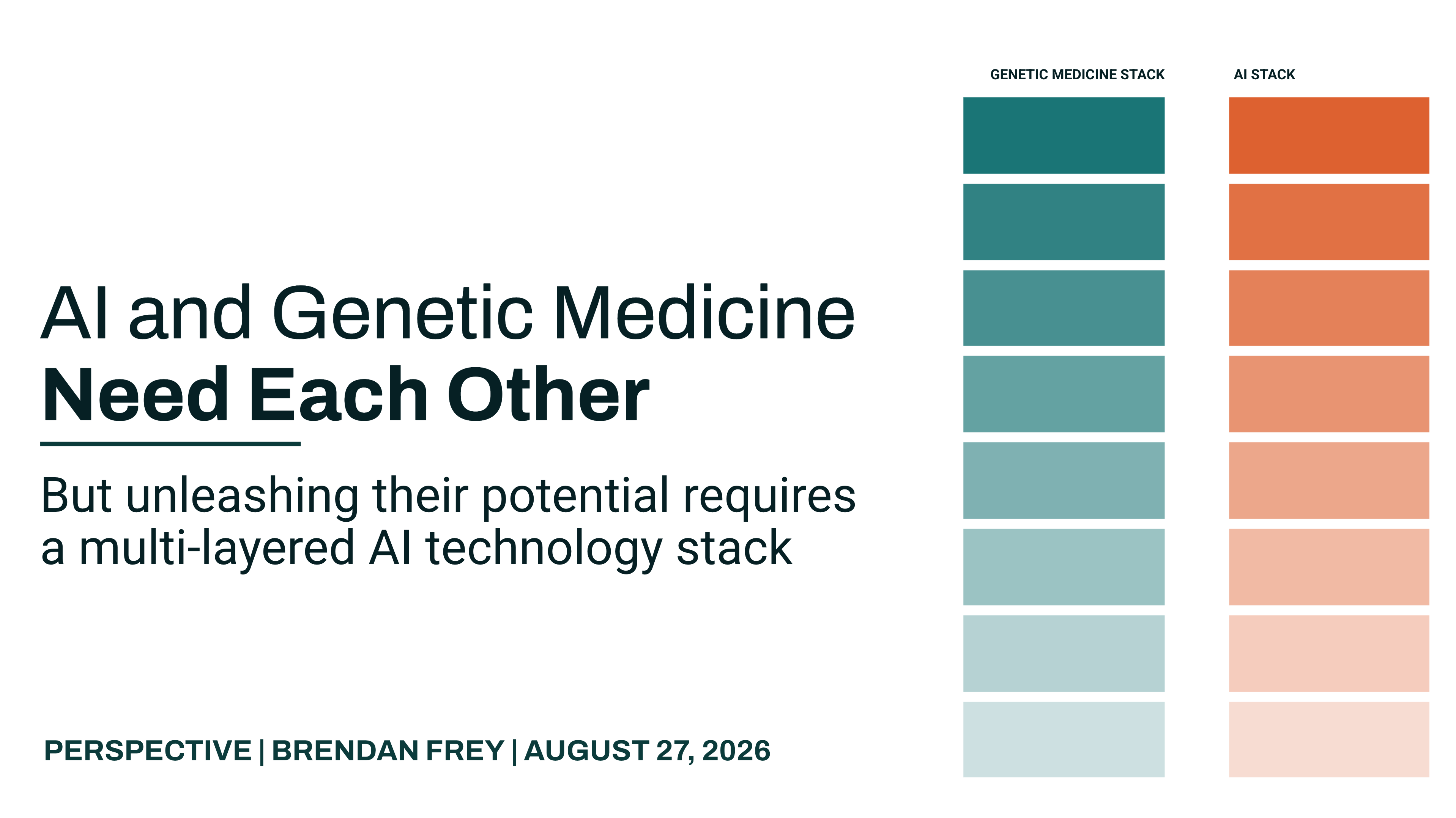
If genetic medicine has an integrated design stack, AI for genetic medicine requires a corresponding integrated technology stack: genomes, population & clinical genetics, sequence and transcript annotations, high-performance genomics tooling, biological foundation models (BioFMs), models of tissue- and species-specific biology, therapeutic sequence & chemistry models, cross-species optimization, fit-for-purpose experimental data generation, model training & validation, and lab-in-the-loop learning.
With AI models operating on the right genomes, transcripts, cell type, species and genetic backgrounds, their outputs can be transformed into representations usable for therapeutic design and their predictions can be continually tested against purpose-built experimental data. The challenge is therefore not simply to build better AI models, but to build the computational and experimental system in which those models can design and test medicines in order to iteratively improve their understanding of the underlying system.
This technology stack also unlocks a wide range of disorders. If you can computationally compress design and preclinical work sufficiently, the addressable unit can move from blockbuster populations, to genetically defined subpopulations, to individual patients. Personalized medicine may not be too far off, since recent N-of-1 frameworks explicitly discuss individualized therapies applicable to only a handful of patients or even one (link to article).
In the AI community, there has been incredible progress in domains where the hypothesis generation and testing loop can be entirely automated and performed in silico, such as software, mathematical proofs, and many areas of robotics. This doesn’t work in biology and medicine, which require laboratory experiments to be in the loop. Because the models must be trained and fine-tuned on fit-for-purpose data, the entire AI stack must operate not once, but repeatedly, and as efficiently as possible, within the familiar design, make, test, analyze and learn paradigm (DMTA). Compared to other areas of AI, this is one of the most challenging aspects of AI for medicine and therapeutics, but one that we are increasingly getting good at.
For the AI technology stack with a lab-in-the-loop to be effective, it needs to be wrapped in engineering systems that are reliable, reproducible and scalable. This includes specialized genomic infrastructure for genome and transcriptome annotation and sequence extraction, variant-aware sequence processing, BioFM inference and fine-tuning, dataset and model tracking, scalable GPU and cloud infrastructure, MLOps and, to support DMTA, experimental automation and data tracking.
All of this has come together in work that we’ll be announcing soon–using seven lab-in-the-loop iterations within one year, we developed a frontier model for siRNA design, called DeepRNAi, and used it to predict on-target effect (potency) and hybridization-dependent off-target liabilities (safety) for 3,599 siRNA candidates for PCSK9. DeepRNAi identified nine siRNAs that met both safety and potency thresholds. Inclisiran was one of them. That’s zero-shot discovery of an approved therapeutic, on a target our model had never seen!
For siRNA design, the full realization of a tech stack requires decoding patient biology, identifying a target, extracting the relevant genomic and transcriptomic sequence—not only for the intended target, but across the transcriptome to identify near-perfect-match and seed-mediated off-targets and determining which transcripts are expressed in the tissue reached by the drug. BioFMs should be used to add representations of splicing, polyadenylation, RNA structure, mRNA stability and other context dependent biology, for the purpose of target identification and also molecular design. These models must be run at enormous genomic scale using the appropriate species and biological context, possibly with fine-tuning on disease data, while accounting for human population variation and repeating the analysis in the relevant preclinical species, such as the cynomolgus population used for testing. These models can be trained on fixed datasets, but are much more powerful when they are part of lab-in-the-loop cycles of iterative development and improvement.
It is illustrative to look at previous failures or setbacks in the field that could have been avoided if the right AI systems had been in place to avoid addressing problems one at a time, as they pop up unexpectedly. There are many examples, ranging from setbacks in biology or molecular design, each involving oversights in one or more of the steps in the full design stack outlined above. Here, we look at one such example: Alnylam’s experience with ALN-HBV.
The lead siRNA passed preclinical safety testing, but in Phase 1 produced dose-dependent liver enzyme elevations that led to a setback to early R&D in 2017. Subsequent work traced the toxicity to RISC-mediated, miRNA-like off-target silencing driven by the siRNA guide-strand seed sequence (Schlegel et al., NAR 2022).
Alnylam redesigned the molecule by introducing a single GNA chemical modification into the seed region, reducing off-target activity while preserving on-target potency. The resulting molecule, ALN-HBV02 (VIR-2218), returned to clinical development and completed a clean Phase 1 study in early 2020.
A full-stack AI model could have identified such liabilities and avoided a late-stage setback by suggesting a seed region-destabilizing modification before doing a single in vitro qPCR experiment. This requires jointly modeling sequence, chemical modifications, RISC loading, on-target potency, transcriptome-wide off-target engagement, and downstream toxicity but is now achievable with the right system in place.
Any one setback like this can be examined retrospectively and the specific problem ‘fixed’, but this approach can lead to whack-a-mole drug discovery, where problems pop up frequently and are dealt with one by one, without achieving efficiency and synergy across the stack. For the AI technology stack to fuel genetic medicine, it needs to be reliable, reproducible, and scalable and I’ll dig in more on these in a future post.
The lesson from the deep learning revolution is that transformative AI models are necessary, but not sufficient. Deep learning took off when data, compute and engineering matured together into a complete technology stack that supported massive scale. Because genetic medicine is full-stack and we can build a corresponding AI stack, they are also approaching take-off. Their advantage is that biology and medicine can increasingly be represented in the same digital language, from patient genetics to therapeutic sequence to molecular response.
There are major challenges, such as building models of patient genomes, complex phenotypic readouts and connecting massive datasets, but we’re nearing a point where the right multi-layer AI architecture will enable explosive growth in a new generation of safe, long-lasting medicines that attack the root causes of disease. Making this transition will unlock huge opportunities in untreated disease and make genetic medicine a dominant approach for the AI era.
In future posts, I look forward to sharing more perspectives, raising key issues in the field, and telling you about progress we’ve made in this revolution at Deep Genomics!
Originally posted on Brenden Frey’s LinkedIn here. Join the conversation!