
.png)
By Albi Celaj, Director, Machine Learning/AI Lab
Previously, Brendan Frey set out a vision for an integrated AI stack for genetic medicine and Greg Hoffman outlined what it means for drug developers. Today, I want to build upon this with something concrete. I’m excited to share our latest-and-greatest results building DeepRNAi and what it could mean for the development of siRNA drugs. This will be the culmination of work we have been doing for over a year at Deep Genomics and I am very proud about what the team here was able to accomplish in this time. This is an important unsolved problem in the field and I think it could really change the siRNA drug design process.
Targeting a gene for silencing with siRNA often triggers off-target effects across the transcriptome, adding risk and delays to the drug development process. Predicting siRNA off-target effects has remained elusive because an accurate model of induced hybridization-mediated knockdown is difficult to develop. The RNA-induced silencing complex (RISC) does not appear to follow straightforward sequencing-matching rules, making it impractical to exclude off-target effects using, e.g. string matching methods or following heuristics based on thermodynamics.
To accelerate the development of potent siRNA drugs with fewer off-target liabilities, we introduce DeepRNAi, a deep learning model to accurately predict transcriptome-wide RISC-mediated knockdown from siRNA drug treatment
.png)
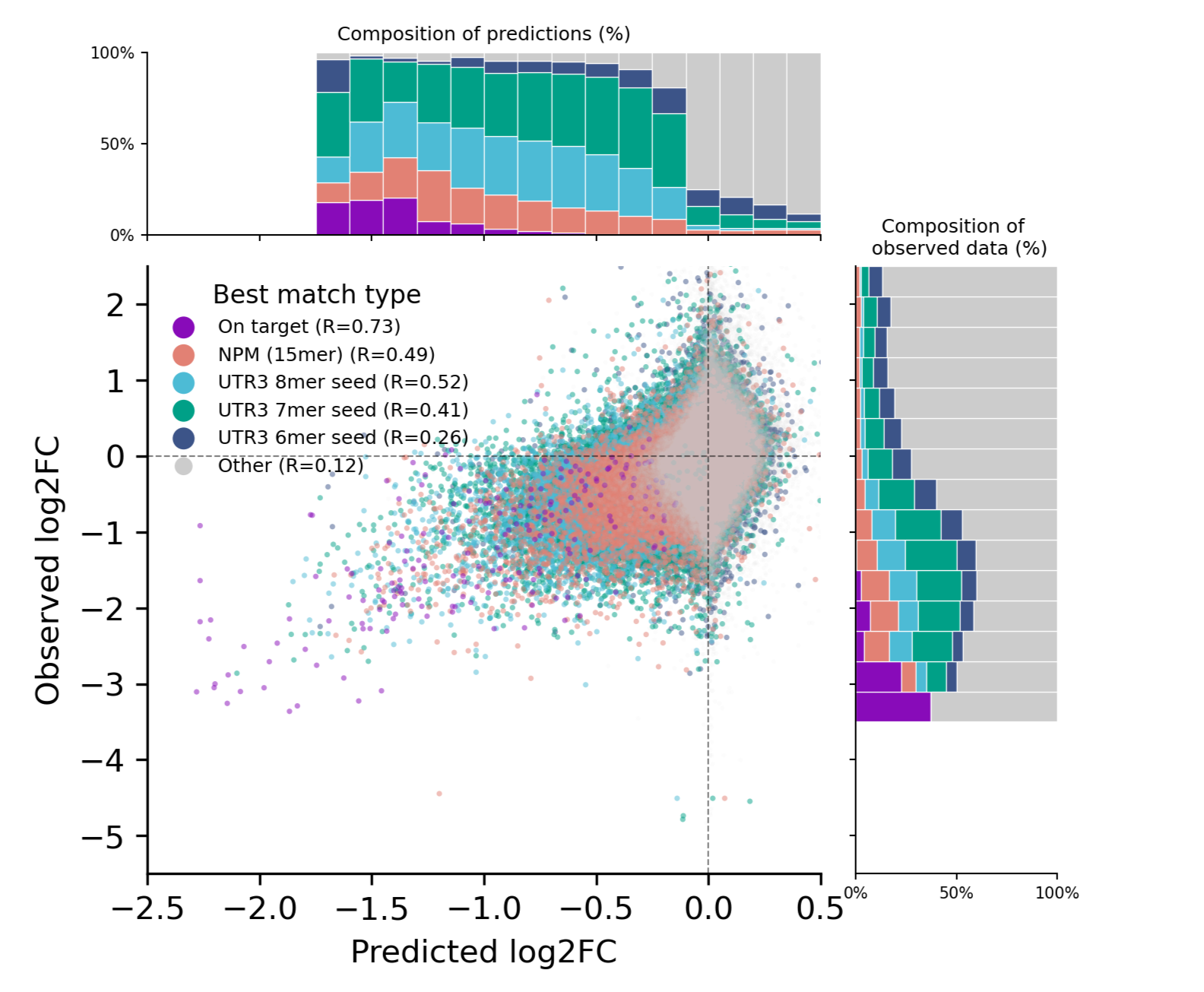
DeepRNAi predicts the knockdown of any siRNA-transcript pair, regardless of sequence complementarity, including intended on-targets, near-perfect matches (NPMs), and canonical seed matches. Overall, when we measure the performance of DeepRNAi on pairs of siRNAs screened in two common preclinical in vitro cell lines, its correlation for NPMs and seed matches is approaching the reproducibility of RNAseq measurements themselves. This made us think that DeepRNAi is accurate enough to reduce (or largely replace) the need for RNAseq in siRNA drug development.
.png)
In addition to each off-target effect adding liability to the drug development process (and reportable to the FDA!), an excess of overall off-target effects has also been linked by Janas et al to heptatoxicity in a rat animal model. When comparing our RNAseq data for hepatotoxic compounds from the Janas study (“Bad Actors”) to five FDA-approved siRNA drugs (“Good Actors”), we saw a difference in the overall off-target burden that could distinguish these two classes. This separation in off-target burden was well-predicted by DeepRNAi, and can be minimized during the drug development process.
.png)
Because DeepRNAi has learned the conserved “rules” of RISC-mediated knockdown, it can even generalise to different species used in the preclinical development. When we applied DeepRNAi to two experiments of rats treated with siRNA, it continued to perform with the high accuracy we observed in our test set in predicting seeds and NPMs. For these two siRNAs, it even did as well as in vitro rat hepatocyte experiments at predicting which NPMs would be down-regulated in an in vivo rat study! This suggests that DeepRNAi can also minimize effects in preclinical animals to avoid off-target-based animal safety signals and potentially lead to fewer animals being used. We also take these results to support that DeepRNAi may have similar potential for in vivo translation in humans.
.png)
Finally, we evaluated how well DeepRNAi ranks Inclisiran, a cholesterol-lowering drug which targets PCSK9. Without having seen any previous siRNAs targeting PCSK9, DeepRNAi scored 3,599 fully complementary siRNAs. Amongst these candidates, the model predicted exceptionally strong knockdown and minimal off-target liabilities for Inclisiran, ranking it to be the most potent compound with low off-target burden.
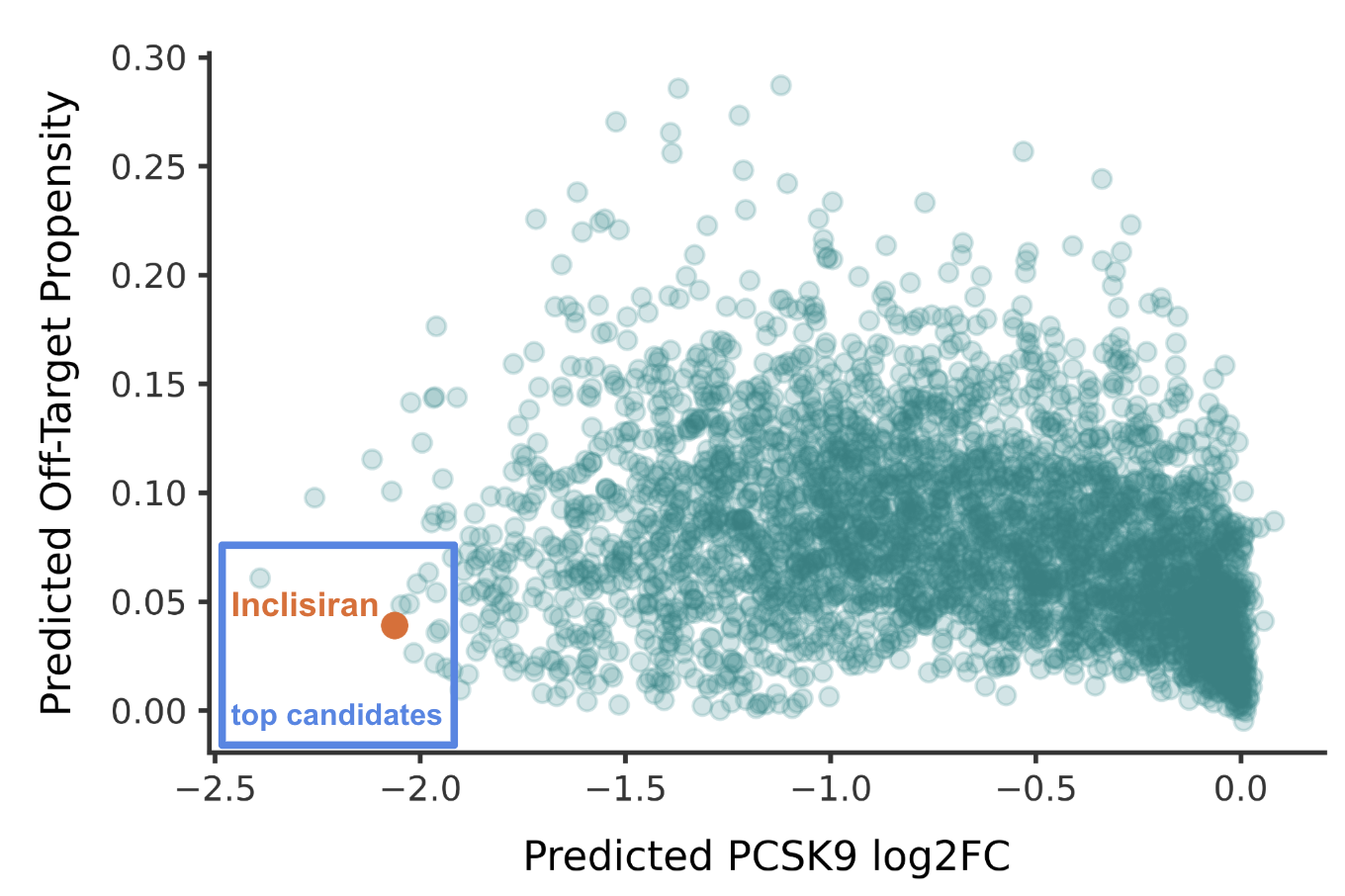
Taken together, these results support using DeepRNAi to prioritize potent siRNAs with fewer predicted off-target liabilities. We are excited to announce this capability to siRNA drug developers. Creating a highly-accurate “virtual screening” model like this was a challenge that required fit-for-purpose data, biological foundation models that encode the appropriate genomic context, and a learning strategy focused on RISC-mediated knockdown.
In future posts, we will go into more depth about the secret sauce that really made DeepRNAi work. For example, in his next post, Scott Findlay will explain how we generated 15 million measurements of potential siRNA–mRNA interactions that allowed us to build a “fit for purpose” dataset that allows us specifically to learn which interactions cause silencing.
To follow along and read our previous pieces, visit the Deep Genomics blog here.