
.png)
By Greg Hoffman, Chief Scientific Officer, Deep Genomics
Brendan Frey made the case that genetic medicine is the full-stack: programmable at the sequence level and unusually well suited to AI. I want to continue that theme with the part of the story I know best: designing the molecule itself.
I have spent my career optimizing genetic medicines using empirical, high-throughput methods. Build the screen, make a few thousand candidates, read out which ones worked. That approach has produced real drugs. It is also slow, expensive. Because the field is focused on finding a therapeutic candidate, we often learn which molecule works, but we don’t always learn why.
AlphaFold showed what becomes possible when learning is the objective: a model learns the underlying rules for protein folding and this becomes immensely powerful. A problem that had consumed careers over a period of 50 years turned into a calculation you run before touching a pipette. Boltz and models like it are now doing the same for small molecule binding.
Genetic medicines are the natural next domain. Every genetic medicine, whether ASO, siRNA, guide RNA, or mRNA, is comprised of a nucleic acid sequence (often with chemical modifications), acting on a target written in that same language. You are not searching an unbounded chemical space for a molecule that might exist. You are choosing among sequences that certainly do exist, or are closely related to those that do. The design sequence design space is discrete, enumerable, and legible to a model. Whether a sequence works depends on everything around it: the folded structure of the transcript, the proteins bound along it, and regulatory elements buried in untranslated regions and introns that no one has annotated. The rules were always learnable. They simply had to be learned.
That is what our BioFM platform does, and it is a large part of why I joined Brendan here.
One example. Sengupta et al. published a screen of over 2037 ASOs tiled across the UTRN 3′UTR, arriving at a lead miRNA-blocking ASO the way this field always has, by making all of them and testing each molecule. We scored the same 2037 sequences computationally with the Deep Genomics BioFM platform. Their lead came back ranked first
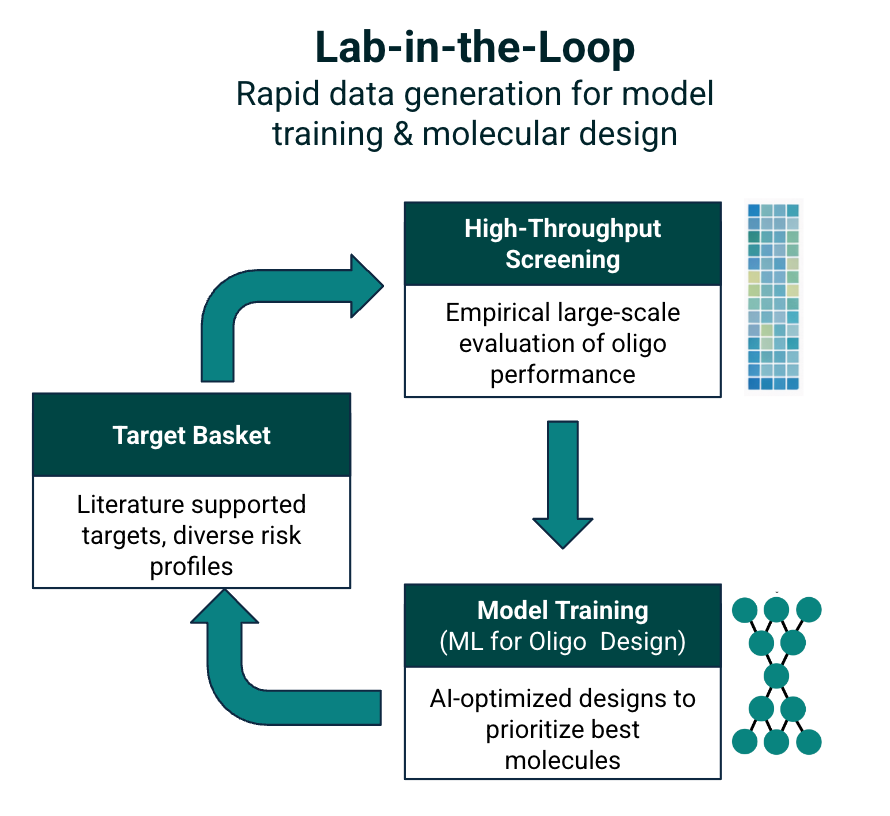
What makes that more than a good anecdote is that it generalizes. The rules our models learned for splicing, the problem Brendan started on back in 2010, turn out to be part of a larger grammar, one that also governs miRNA binding, RNA-protein interactions, siRNA knockdown, and ADAR guide RNAs for RNA editing. One platform, three modalities, and no reason to stop there: CRISPR guides, mRNA design, the expression cassettes inside AAV gene therapies. If the medicine is made of nucleic acid, it is in scope.
The consequence is not that experiments go away. It is that they change jobs. We stop screening to find a molecule and start screening to teach a model, then design against it. Or, we screen a set of candidates that is 10x better than what others are screening: siRNAs without off-target hybridization effects, for example. That is a different economics entirely: our last in-silico screen covered 300,000 RNA-editing guides, about thirty pooled experiments' worth, and the bench work went to the questions the model could not yet answer.
None of which works without the right data underneath it. The datasets most of the field trains on are small, noisy, and frequently measuring something adjacent to the effect you actually care about. Sorting that out turned out to be the harder half of the problem, and the more interesting one.
That is the next post.
Read our previous post by Brendan Frey, Founder and CIO: "AI and Genetic Medicine Need Each Other."